For credit card issuers, banks, merchants, and other financial institutions, being top-of-wallet means increased revenue, high levels of customer loyalty, and valuable consumer insights. Earning the top spot in the consumer’s mind demands convenience, unique rewards, and exceptional service to cardholders.
However, the payment landscape has shifted dramatically over the last decade, and a new customer need has emerged – Privacy. With the rise of digital wallets and other payment methods, the game is changing quickly for credit card issuers to maintain top-of-wallet status. To stay competitive, credit card issuers must provide a convenient, secure, and rewarding payment experience and meet the new demands of privacy and connectivity that modern consumers have come to expect.
In this post, we’ll explore the importance of privacy in achieving top-of-wallet status and some of the latest trends and technologies driving the future of payment.
Balancing Convenience, Privacy, and Security in the New Payment Game
With the rapid evolution and adoption of digital wallets and payment methods, data privacy and security have become a priority for providers seeking a competitive edge. Consumers now expect a frictionless and convenient payment experience that doesn’t compromise their data security or privacy.
With the alarming increase in data breaches and identity theft cases, new digital wallets and payment methods, especially those that continue to use traditional forms of authentication (one-time passwords sent via SMS and email), put their account holders at risk of account takeover attacks (ATO). For newer modes of payment that adopt biometric factors like face and palm biometrics, giving consumers the confidence that their biometric data is secure and isn’t used for unintended reasons is becoming a key factor in their decision on whether to use the new technology.
Therefore, by prioritizing privacy in their offerings, payment service providers can earn consumers’ trust and emerge as top-of-wallet options.
How Can Payment Providers Prioritize Privacy to Secure Top-of-Wallet Status?
In the quest to strike the perfect balance between convenience, security, and privacy in the new payment game, biometric authentication has emerged as one of the most promising solutions. Biometrics such as facial recognition and palm scanning provide a unique and difficult-to-impersonate form of identity verification while preventing fraud such as account takeover.
JP Morgan recently announced its approach to satisfying convenience and security by introducing a biometric payment method. Customers enroll using an in-store process to link their palm or face biometric with a credit card or other form of payment. After enrollment, customers can simply scan their faces or palm to pay at checkout.
There are several benefits of biometrically authorized payments, including:
- Always on hand: There is no need to reach for your wallet, which can help streamline the payment process and minimize the amount of personal information that needs to be shared.
- Unique and difficult to impersonate: A stolen card can be charged immediately, but it is much more difficult to impersonate someone’s face or palm.
- Non-transferrable: biometrics are bound to the individual, which makes chargeback and friendly frauds much more difficult to perpetrate. This reduces costs related to fraudulent transactions.
With the weight of JP Morgan behind it, other banks, fintech, and merchant acquirers will need to show ways to match or surpass this innovation.
Ensuring Biometric Privacy and Security for Consumers
When designing any sort of biometric system, in particular one for payments that may be shared across merchants and providers, the privacy and security of the underlying biometric information are paramount. Trust Stamp’s approach considers consumer privacy while adding convenience to a consumer’s experience.
Every biometric system creates a biometric template, which is essentially the measurements between different facial or palm features. If biometric templates are compromised, they cannot be “reset” like a password or replaced like a credit card number. With more merchants and consumers participating in these sorts of systems, the data breaches we have grown accustomed to hearing about will start to include biometric data. This is why the tokenization of a biometric is important.
The tokenization of credit card numbers is a great example of how to handle biometric information securely. Tokenizing credit card numbers involves replacing sensitive card information with a unique, non-sensitive identifier called a token. The original card data is securely stored in a separate, centralized token vault. This process helps protect sensitive cardholder data from theft or unauthorized access, as merchants and service providers only handle the token, not the actual card number.
The Benefits of a Privacy-First Biometric Payment Process
In addition to enhancing security and preventing fraud, a privacy-first biometric payment process provides a number of benefits for consumers and businesses alike. Some of these benefits include:
- Improved User Experience: With a biometric payment system, users can simply scan their face or palm to pay, eliminating the need to pull out their wallet or even their phone. This makes the payment process quick and convenient, improving the overall user experience.
- Greater Convenience: Biometric payment systems offer greater convenience than traditional payment methods. Users don’t need to remember passwords, carry cash or cards, or even take out their phones to pay. The system is designed to be fast, easy, and seamless.
- Enhanced Data Security: By tokenizing biometric data, privacy-first biometric payment systems provide enhanced data security. Even if the token is compromised, the biometric data cannot be reconstructed or used for fraud. This helps protect consumers from identity theft and other types of financial fraud.
- Increased Customer Loyalty: Offering a privacy-first biometric payment system can help businesses increase customer loyalty. By providing a convenient, secure, and privacy-first payment option, payment providers can create a positive impression with their customers and encourage repeat business.
Become Top-of-Wallet with Trust Stamp’s Methodology
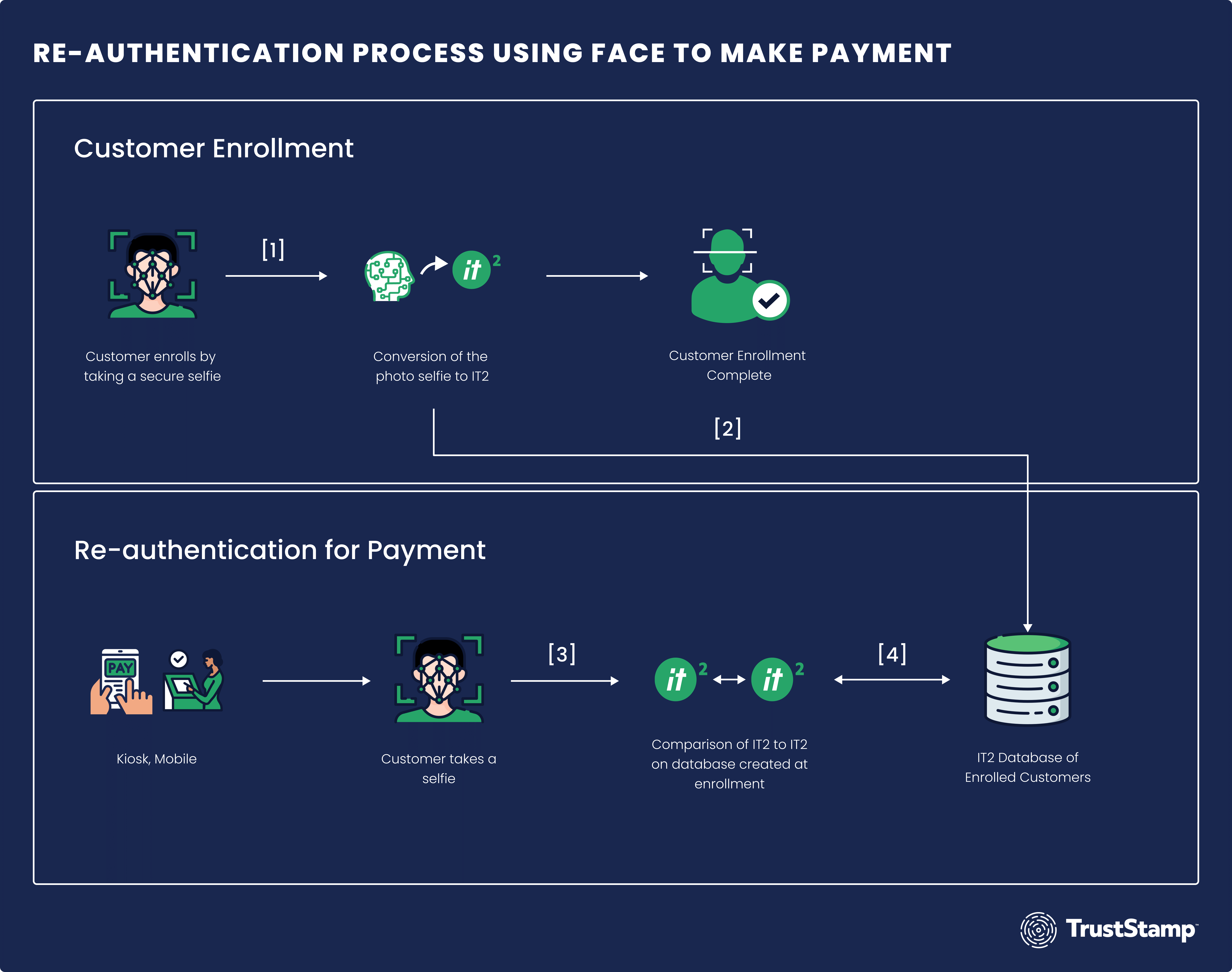
Trust Stamp provides security and privacy for the customer and security for the institution by similarly treating biometric data. Trust Stamp converts the biometric template into a token [1], called an Irreversibly Transformed Identity Token (IT²). Although each IT², even for the same user, is different, the tokens of the same user are probabilistically matched [2] without needing to keep any pictures or the biometric template. Those can be deleted entirely. Adding Trust Stamp’s IT² layer to any biometric system enables a consumer to enjoy the convenience of biometrics without fear of losing their biometrics to criminals.
When a consumer pays using their biometric, a new IT² is generated [3] and matched to a CRM of IT² [4], allowing consumers to enjoy all the benefits of biometric payment with enhanced data privacy and security.
By adopting a privacy-first approach to biometric payments, businesses can earn the trust and loyalty of their customers while also generating profits and insights. Contact Trust Stamp today to learn how the IT² facilitates easy payments, prevents fraud, and enhances data security and consumer privacy.